
The short answer
Your garage door is almost certainly the largest, weakest opening in your home's exterior walls, and the wind and storm season Southeast Michigan gets in fall is exactly when that weakness gets tested. A door that's out of balance, loosely tracked, or fitted with cracked weatherstripping can flex, rattle, or even blow in during a strong gust — and once it fails, wind pressure gets into the garage and pushes up on the roof from the inside. The fix is a straightforward fall inspection and a handful of adjustments, done now, before ice and road salt make everything harder to work on.
Why the garage door is your home's weakest wall
Every other exterior wall in your house is a solid, continuous surface anchored directly into the foundation. The garage door is different: it's a large panel, usually 7 to 9 feet wide and made of several sections, held in place by thin tracks, rollers, hinges, and a spring system doing all the structural work. There's no solid wall behind it — just moving parts under tension.
When wind pushes on a house, pressure builds on the windward side and drops on the roof and leeward side. If the garage door holds, that pressure stays outside. If the door buckles or blows in, air rushes into the garage, pressurizes the whole structure from underneath, and puts uplift stress on the roof deck. This is the same reason commercial and coastal building codes call out wind-rated garage doors specifically — the failure point is rarely the walls, it's the door.
Signs your door won't hold up to wind and storms
- Visible flex or bowing in the panels when the wind gusts, especially on wider two-car doors.
- Rattling or banging along the track during storms, which usually means loose rollers, worn hinges, or a track pulling slightly away from the frame.
- Daylight gaps along the sides or top of the door — a sign the weatherstripping has hardened and shrunk from a summer of UV exposure and is no longer sealing.
- A door that's hard to lift by hand or slams down fast when released, which points to weak or unbalanced springs that won't hold the door steady under wind load.
- Brackets or hinges with play in them when you wiggle the door by hand from inside.
Any one of these is worth addressing before the next windstorm, not after.
Steps to storm-proof your garage door this fall
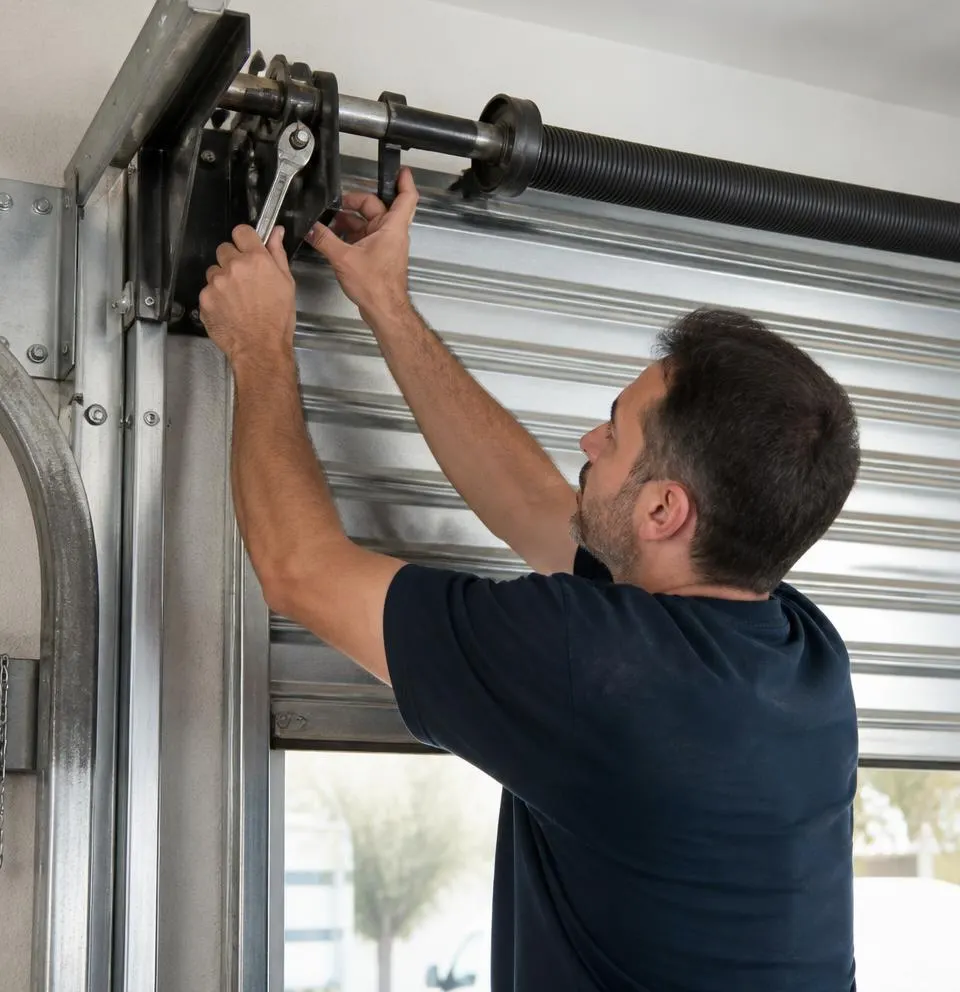
- Inspect and tighten hardware. Walk the full perimeter of the door and check every hinge, roller bracket, and track bolt. Vibration from a summer of storms loosens fasteners gradually; a quarter-turn on a dozen bolts makes a real difference in how much the door flexes.
- Check the track alignment. Tracks should run straight and parallel with no visible gaps between the track and the wall mounting. Even a slightly bent track lets the door rock side to side under wind pressure.
- Replace brittle weatherstripping. The rubber seal along the bottom and sides does more than block drafts — it's part of what keeps wind-driven rain and pressure from forcing their way in. If it's cracked, flattened, or pulling away from the door, replace it now, while it's still easy to handle. Cold rubber in January is stiff and much harder to work with.
- Have springs checked for balance. A door that's properly balanced moves smoothly and stays wherever you leave it when lifted halfway by hand. If it drops on its own or is noticeably heavy, the springs are losing tension and won't hold the door steady when wind is pushing against it. This is also the kind of repair you want done before deep cold sets in, since cold makes torsion springs more brittle and more likely to snap.
- Add reinforcement if the door is older or wasn't built for wind load. Retrofit strut kits that brace the horizontal panels can stiffen an existing door considerably and are far cheaper than full replacement.
- Clear and lubricate the tracks and rollers. Summer storms wash dust and pollen into the hardware; a clean, lubricated track reduces friction and lets the door's safety mechanisms respond properly if something goes wrong mid-storm.
Don't forget the opener
Severe fall storms in this area often bring power outages along with the wind. A standard opener won't function without electricity, which means a door that's closed during a storm stays closed until power returns — fine for security, less fine if you need to get a vehicle out. If that matters for your household, a battery backup unit for the opener is a reasonable investment, and it's worth testing your manual emergency release cord now so you know it works before you actually need it in the dark.
When to call Beverly Hills Garage Door
If your door is rattling in the wind, sitting unevenly in its tracks, or the springs feel off when you test the balance, that's the point to bring in a technician rather than keep adjusting it yourself. Our garage door maintenance service covers the full inspection — hardware, track alignment, weatherstripping, and spring tension — and catches the small issues before a storm turns them into a failed door. If a spring is already showing wear, our spring replacement service gets it swapped out and rebalanced correctly, which matters more once cold weather makes springs more prone to snapping under stress.
If you're in Beverly Hills, Southfield, Birmingham, Royal Oak, Lathrup Village, Franklin, Bloomfield Hills, or Berkley and want your garage door checked before the next round of fall storms rolls through, call Beverly Hills Garage Door today and get it handled while the weather still makes it easy.